Dental Implants Are a Permanent Fix, But Not an Automatic One
Summary
Dental implants replace a missing tooth's root with a titanium post that fuses with the jawbone, then support a crown, bridge, or denture on top. This article explains the three-phase surgical process, who is and isn't a strong candidate, and what long-term research actually shows about how long implants last and who is more likely to lose one. It also looks at how common tooth loss remains among adults and how that shapes the decision to consider dental implants in the first place.
A missing tooth rarely stays a cosmetic problem for long. The gap changes how neighboring teeth drift, how the jawbone underneath begins to resorb, and how a person chews, speaks, and smiles without quite realizing they've started compensating for it. Dental implants exist to interrupt that slow chain of consequences by replacing not just the visible crown of a tooth but the root beneath it, something bridges and dentures were never designed to do.
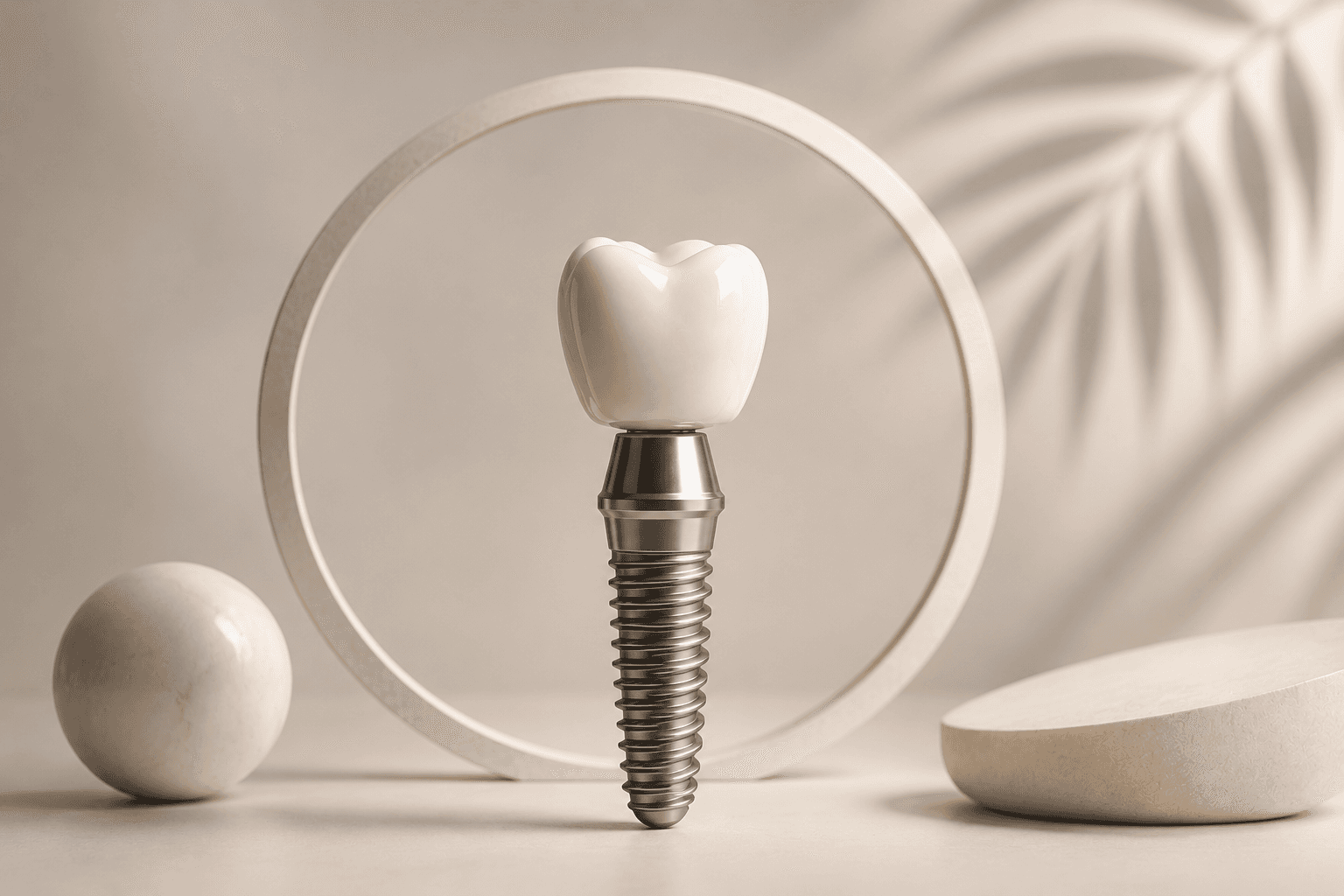
That distinction is why dental implants are often described as the closest replacement to a natural tooth available in modern dentistry. The American Dental Association calls them one of the biggest advances in dentistry in the past 40 years. American Dental Association The reason isn't cosmetic. A titanium post placed into the jawbone fuses with living bone tissue, giving the replacement tooth a stable, load-bearing foundation that a removable denture simply cannot replicate.
None of that makes dental implants the automatic right choice for every missing tooth. The procedure has a real healing timeline, genuine candidacy requirements, and long-term survival data that varies meaningfully by age and health status. Understanding what actually happens during treatment, who tends to do well with dental implants, and what the research says about longevity turns an emotionally loaded decision into a more grounded one.
What Actually Happens During Dental Implants, Step by Step
Dental implants are not a single procedure but a sequence of distinct phases, and the gap between them is often the part patients are least prepared for. The process typically unfolds in three stages: surgical placement of the implant post, a healing period during which the bone fuses around it, and finally the attachment of the visible replacement tooth.
The scope of that process also depends on how many teeth are being replaced. A single missing tooth generally needs one implant post supporting one crown. Several missing teeth in a row can often be restored with an implant-supported bridge anchored by just two or three implants rather than one per gap, and a full arch of missing teeth can sometimes be replaced using as few as four to six implants supporting a complete fixed denture a very different treatment plan from replacing a single tooth, even though the underlying biology of dental implants is the same in both cases.
The first phase involves administering anesthesia, making a small incision in the gum to expose the jawbone, and placing a small, threaded titanium post into the bone itself. Cleveland Clinic describes the sequence in practical terms: the gum is repositioned and closed with stitches after the post is placed, and the entire surgical appointment for a single dental implant typically runs under two hours. Cleveland Clinic Some patients recover their permanent restoration and implant placement in a single visit, while others require a temporary tooth while the site heals. Immediately afterward, a soft-food diet is generally recommended, and mild discomfort or swelling in the days following surgery is normal and expected rather than a sign of a problem patients do not feel pain during the procedure itself, since it is performed under anesthesia.
Osseointegration Is What Makes Dental Implants Different From Other Tooth Replacements
The middle phase is biological rather than surgical, and it's the step that distinguishes dental implants from bridges or dentures. Once the titanium post is in place, the surrounding jawbone gradually grows around it in a process called osseointegration the bone doesn't just sit next to the implant, it fuses to its surface. According to Cleveland Clinic, initial healing takes about a week, but the bone fusion itself typically takes three to nine months depending on bone density, implant location, and individual healing capacity.
That waiting period is not wasted time; it's the mechanism that gives dental implants their stability. A denture rests on the gum and can shift during chewing. A bridge relies on neighboring teeth for support and places extra load on them over time. An implant that has fully Osseo integrated functions much more like a natural tooth root, distributing bite force directly into the jawbone rather than onto surrounding structures.
From Post to Finished Tooth
Once osseointegration is complete, a connector piece called an abutment is attached to the implant post, and the final restoration a crown for a single tooth, a bridge for several, or a full denture anchored by several implants for a full arch is fitted on top. This final visit is comparatively quick, often taking about an hour, and it's the step that finally makes dental implants indistinguishable in daily use from the teeth around them.
Who Is (and Isn't) a Strong Candidate for Dental Implants
Overall health matters more for dental implants than age does on its own. A person's ability to heal, the quality of the jawbone available to anchor the implant, and how well any existing gum disease has been managed all weigh more heavily in a candidacy decision than the number on a birth certificate.
Certain conditions genuinely complicate the process. Chronic illnesses such as diabetes or leukemia can interfere with healing after surgery, and active or untreated gum disease is one of the more common reasons a patient needs preliminary treatment before dental implants can move forward safely. American Dental Association Smoking and vaping are treated as significant risk factors as well, since tobacco use measurably slows the healing that osseointegration depends on.
That gum disease requirement is worth taking seriously rather than treating as a formality. Placing an implant into bone that's still fighting an active periodontal infection undermines the entire premise of osseointegration the bone needs to be healthy enough to fuse with the implant surface, not inflamed and actively losing density. This is one of the more common reasons a treatment timeline for dental implants stretches longer than a patient initially expects: a course of periodontal treatment sometimes has to run its course and stabilize before implant placement is even scheduled, let alone completed.
Bone Health Shapes Whether Dental Implants Are an Option Right Away
Severe jawbone loss is one of the more practical obstacles to dental implants, particularly for patients who have gone without a tooth for years, since the bone in that area tends to resorb over time without a root to stimulate it. This doesn't automatically rule someone out bone grafting can sometimes rebuild enough density to support an implant but it does mean the timeline and complexity of treatment can expand considerably depending on how long a tooth has been missing.
Dental Implants for Patients Over 65
Age alone isn't a disqualifier, and the minimum age for dental implants is really the only hard cutoff on that axis typically 18, once jaw growth is complete. But age does interact with long-term outcomes in a way that's worth naming plainly: research on implant survival has found that older patients experience measurably lower long-term success than younger ones, which is a factor worth discussing directly with a dentist rather than assuming age is irrelevant to the decision.
How Long Dental Implants Actually Last, According to the Evidence
The claim that dental implants can last a lifetime is true often enough to be the headline, but it isn't universal, and the research behind it is more nuanced than a single number suggests. A large meta-analysis pooling 18 prospective studies on contemporary implant systems found a 10-year survival rate of 96.4% using traditional statistical methods. PubMed That figure alone would suggest dental implants fail only rarely over a decade.
The same research team then ran a more conservative sensitivity analysis that accounted for patients lost to follow-up during the study period people who simply stopped showing up for check-ins, some of whom may have had implant complications that went unrecorded. Under that more realistic model, the 10-year survival rate dropped to 93.2%, and for patients aged 65 and older specifically, it fell further to 91.5%.PubMed The authors describe this as roughly a doubling of failure risk in older age groups compared with younger patients a meaningful gap, even though the majority of implants in every age group examined were still functioning well at the ten-year mark.
What Changes the Odds for Dental Implants Long-Term
That gap doesn't mean older patients should rule out dental implants; it means the conversation with a dentist should be more specific about individual bone health, healing capacity, and realistic expectations rather than relying on population averages. Day-to-day maintenance also plays a measurable role apart from age. Cleveland Clinic notes that with consistent brushing, flossing, and regular dental visits, implants can often last a lifetime, while the crowns or bridges attached to them typically need replacement after about 15 years of normal wear, and implant-supported dentures roughly every seven years or more.
That distinction matters practically: the titanium post itself is the most durable part of the system, while the visible restoration on top is the component more likely to need eventual replacement a difference worth understanding before assuming "permanent" means "never touched again."
What the Data on Tooth Loss Says About Who Actually Needs Dental Implants
Understanding how common total tooth loss actually is helps explain why dental implants have become such a routine part of restorative dentistry rather than a rare intervention. According to NIDCR data drawn from the 2017–March 2020 National Health and Nutrition Examination Survey, about 2% of U.S. adults aged 20–64 have lost all of their natural teeth, and the average adult in that age range still retains 25.5 of their original 32 teeth. NIDCR That number climbs with age 1.2% among adults 35–49 and 5.9% among adults 50–64 which tracks with the cumulative, decades-long process that leads most people toward needing a replacement tooth in the first place.
The same data shows meaningful progress over time: complete tooth loss among adults fell from 3.8% in 1999–2004 to 2.2% in 2011–2016 and 2.0% in the most recent survey period, a trend generally credited to better prevention, fluoride access, and earlier intervention. But the data also shows the risk isn't distributed evenly. Current smokers have a 7.6% edentulism rate, adults living in poverty face 6.8%, and those without a high school education face 4.2% several times the general population's rate, and a reminder that the habits and access issues driving tooth loss are the same ones that make consistent, minimally invasive dental care valuable long before dental implants ever become necessary.
Prevention Still Comes Before Dental Implants, Not After
None of this diminishes what dental implants offer once a tooth is genuinely unsalvageable. But the data is a useful reminder that the decision tree usually starts earlier — with treating decay, gum disease, and cracked teeth aggressively enough that extraction and replacement remain a last resort rather than a routine outcome. For patients already facing tooth loss, though, comprehensive evaluation matters more than guesswork. Dentika's dental care services can help determine whether an existing tooth is worth preserving or whether dental implants represent the more durable long-term solution.
Making a Confident Decision About Dental Implants
The honest picture of dental implants sits between two extremes: they are not a guaranteed-forever fix that never requires thought again, and they are not the risky, unpredictable procedure some patients fear based on secondhand stories. They are a well-studied restoration with a strong long-term track record, a real healing timeline, and outcomes that depend meaningfully on individual health, bone quality, and age.
The right question isn't whether dental implants work the research settles that clearly enough. The more useful question is whether a specific patient's bone health, medical history, and habits make them a strong candidate now, or whether some groundwork needs to happen first. Diabetes that's well-managed looks different from diabetes that isn't. A patient who quit smoking six months ago is in a different position than someone still using tobacco daily. Bone that's been resorbing for a decade needs a different conversation than bone that's still structurally sound.
Dental implants reward patience during the healing phase and consistent care afterward brushing, flossing, and regular checkups the same way natural teeth require, just with a lower long-term risk of the decay that likely caused the original tooth loss. For anyone missing a tooth and weighing the options, scheduling a consultation with Dentika is the most direct way to find out whether dental implants are the right next step, based on an actual clinical picture rather than general statistics alone.
How painful is getting dental implants?
+
Patients don't feel pain during the implant surgery itself, since it's done under anesthesia. Afterward, mild discomfort and swelling for a few days is normal and generally manageable with over-the-counter pain relief, similar to recovery from a tooth extraction.
How long does the entire dental implants process take from start to finish?
+
It varies by case, but the bone-fusion phase alone typically takes three to nine months, and some patients need additional time beforehand for bone grafting or gum disease treatment. A few patients qualify for same-day implant and restoration placement, though that's the exception rather than the norm.
Can someone with diabetes get dental implants?
+
Diabetes doesn't automatically rule someone out, but it is a condition that can interfere with healing after surgery, so well-managed blood sugar matters more than the diagnosis itself. A dentist will typically want to confirm the condition is under control before proceeding.
Do dental implants really last a lifetime?
+
Often, yes, research following patients for a decade found roughly 93% of implants still functioning under realistic follow-up conditions, and the titanium post itself is built to last indefinitely with proper care. The crown or bridge attached to it, however, typically needs replacement after about 15 years of normal wear.
How do I know if dental implants are the right choice instead of a bridge or denture?
+
That depends on the number of missing teeth, the health of the surrounding jawbone, and personal priorities around stability, maintenance, and cost. A comprehensive dental evaluation is the most reliable way to compare the realistic pros and cons for a specific mouth rather than relying on general guidance alone.


